
There is a question I keep circling, in my work and in the books I keep on the nightstand: who decides, and how?
Not in the abstract. Specifically. When a campaign needs to move quickly, when a coalition is fracturing, when a community is under threat — who calls it? On what authority? With what consent? And what happens when the person calling it is wrong?
Science fiction has been arguing with itself about this question for a hundred years. It gives us crews and councils and prophets and lone survivors and hive minds and ragtag teams of misfits, and it asks us, again and again: what kind of structure actually keeps people alive and free?
I don't think there's a single answer. But I think the genre has narrowed the question in useful ways. So let's talk about it.
When hierarchies actually work
Let me say something that may be unfashionable in some of the spaces I move through: hierarchies are not inherently bad. They are a tool. Like every tool, they are useful for some jobs and disastrous for others, and a lot of organizational suffering comes from using the wrong tool for the wrong job.
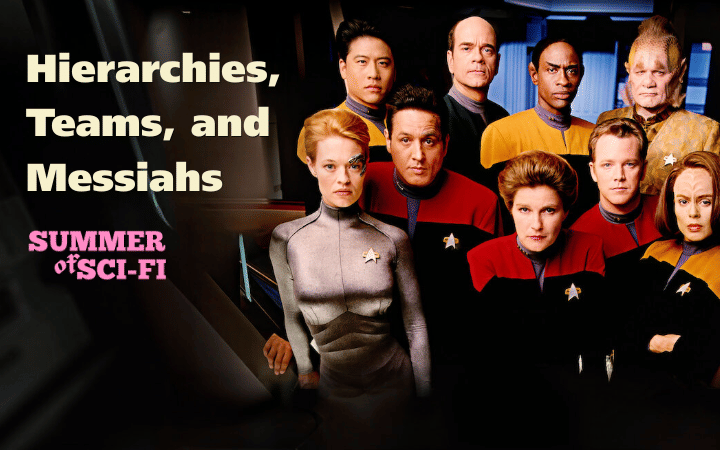
Star Trek is the cleanest defense of functional hierarchy in popular culture, and I think it deserves more credit than it gets from anti-authoritarian readers. The bridge crew of the Enterprise — or Voyager, or DS9 — operates on a clear chain of command. The captain makes the final call. The first officer pushes back. The chief engineer tells you what's actually possible. The doctor refuses orders that violate medical ethics. Every role has both authority and a defined scope of dissent.
What makes this work, when it works:
Every person has a role they're trained for and that the group respects. The hierarchy isn't about who is more valuable as a human. It's about who is responsible for what.
Decisions have to be made on timescales where deliberation isn't possible. A torpedo is incoming. A crew member is dying. The Romulans are decloaking. Consensus is a luxury you sometimes do not have.
There are mechanisms to challenge the hierarchy without destroying it. Picard listens to Riker. Janeway listens to Tuvok. Sisko listens to Kira. The protocols for dissent are part of the structure, not a betrayal of it.
The hierarchy serves the mission, and the mission is collective. The Federation isn't a corporation maximizing shareholder returns. The chain of command is in service of something the crew has actually consented to.
When I write this out you know what this sounds like? A very useful model for fast-moving advocacy work. When a campaign is in crisis at 11pm on a Friday and a decision has to be made about whether to respond to a journalist, you don't run a consensus process. You have a person who is responsible for that call, and you have agreed in advance who that person is, and you trust them to make it because you trust the structure that put them there.
The key to this working however, is that people helped build the process ahead of time and can question when it doesn’t work.
The trouble starts when any of those conditions fail.
Where the line is — when hierarchy curdles into oppression
The line is roughly here: a hierarchy becomes oppressive when the people inside it cannot meaningfully consent to it, cannot meaningfully challenge it, and cannot meaningfully leave.
Alien is, among other things, a film about exactly this failure. The crew of the Nostromo are not Starfleet officers on a noble mission. They are commercial tow workers contracted by the Weyland-Yutani Corporation. They have a chain of command, but the chain of command is not really about their survival — it's about the company's interests, which include the bioweapon now loose on their ship. Ash, the science officer, is literally a corporate plant whose loyalty is to the cargo, not the crew. The crew can't leave. They can't fire him. They can't override him until they figure out, far too late, what he actually is.
That's the structural horror of Alien. The xenomorph is terrifying, but the hierarchy is the real villain — because it was designed to extract value from the workers and considers them, on the corporation's spreadsheet, expendable. Ripley survives by breaking the chain of command. The film does not punish her for this. The film treats it as the only sane response.
Silo — both Hugh Howey's books and the Apple TV adaptation — extends this critique into something even bleaker. The hierarchy of the Silo is total, and incredibly visible, with highest ranking officials living at the top and working labourers living at the bottom. The Judicial maintains order; IT controls information; the Mayor performs leadership; the citizens at the lower levels do the labour. Everyone has a role. The hierarchy appears to function. Until you realize the entire system is built on a lie maintained through ritualized violence — cleanings — performed on anyone who asks the wrong question. The hierarchy is not protecting people. It is protecting itself, and the secret at its core. The horror is how legible it all is: every individual in the system can tell themselves they're just doing their job, and the system continues. But it is also a great map of how to flip the hierarchy, when the labourers realize their collective power they can force Judicial and IT to start meeting them half way – but it doesn’t come without consequence. Flipping power doesn’t eradicate power dynamics, it just shifts them.
The Matrix gives us the most stylized version. The machines have built a hierarchy where humans are batteries, kept docile by an immersive lie. Nobody chose this. Nobody can challenge it from inside. The exit costs are catastrophic. This is the structural form that hierarchy takes when consent is impossible: it doesn't look like tyranny in the dramatic sense. It looks like the totally ordinary, totally rational continuation of business as usual.
The test isn't whether there's a chain of command. The test is what the chain of command is for, and whether the people inside it have the standing to refuse it.
So is the answer to become a lone wolf?
A lot of us, when we recognize a hierarchy as oppressive, are tempted by the opposite extreme. Just go alone. Build your own thing. Trust no one. Become the kind of self-sufficient survivor who doesn't need a team because the team is always corrupted by the structure. I’m no exception, I build my own business to work under my own principles and autonomy.
Science fiction has thought about this a lot, and its answer is mostly: no, that doesn't work either. (Also why I work with other people).
Octavia Butler's Parable of the Sower is the clearest case. Lauren Oya Olamina grows up in a walled neighbourhood in a collapsing California. The hierarchy she was born into — the family, the church, the gated community — fails. She forms Earthseed not as a solo escape but as a new kind of collective — built deliberately, with stated principles, with explicit attention to who is in and how decisions are made and what is owed to whom. The book is a manual for building intentional community in the ruins of failed institutions. Lauren is not a messiah, even though she becomes a religious figure. She is something more like an architect.
Battlestar Galactica hammers this point relentlessly. The few characters who try to operate as lone wolves — Baltar in his self-protective opportunism, Cain in her militarized authoritarianism, the various "I'll handle this myself" arcs — tend to make catastrophic mistakes that cost other people's lives. The characters who survive and remain ethical are the ones who keep returning to the collective, even when the collective is exhausting, even when the collective is wrong, even when the collective humiliates them. Adama is not a lone wolf. Roslin is not a lone wolf. They are people who hold authority while remaining accountable to the fleet, and they fail badly whenever they forget that the accountability is the point.
The Leftovers is interesting here because it gives us the people who go alone — the Guilty Remnant, the various cult escapees, the characters who decide that other people are no longer survivable. The show treats their isolation with compassion and treats it as a tragedy. To be cut off from other humans is to lose access to the meaning-making that humans only do together. The show doesn't moralize about this. It just observes, with great patience, what happens to a person who tries to carry an unbearable thing alone.
The lone wolf is, in the genre's recurring argument, a person who has not yet found a community worth the risk. Not a sustainable position. Not, as it turns out, even an admirable one. Just a way station between one form of belonging and the next.
The messiah problem
Which brings us to the seductive middle option: maybe what we need is a single, exceptional person who can lead us through. A messiah. We see this in politics big time, but also when we put activists on pedestals.
This is the trap that science fiction has spent the most ink warning us about, and it is also the trap that political movements — including, sometimes, the ones I work with — fall into most often.
Frank Herbert wrote Dune explicitly as a warning, and certain demographics mostly read it as a triumph. That's the central irony of the franchise. Paul Atreides is intelligent, compassionate, suffering, and visibly horrified by what he is becoming. He is also, by the end of the first novel and certainly by the second, the engineer of a jihad that will kill billions. The Fremen were perfectly capable of liberating themselves. The Bene Gesserit planted the messianic prophecy specifically because messiahs are useful tools for manipulation. Paul knows this. Paul still steps into the role. And the cost falls on everyone who needed liberation but did not need to be liberated by him.

Herbert's argument, as clearly as he made it: the worst political outcome is being led by a good man who believes in his cause. Bad leaders can be opposed. Charismatic righteous leaders are very difficult to oppose, because the cost of opposing them is the loss of the cause itself. So you don't oppose. You follow. And the followers' moral agency is gradually displaced into the leader's vision, and the leader becomes, structurally, unaccountable.
Star Wars is the same trap with a softer wrapper. Luke Skywalker is the chosen one. Anakin was the chosen one before him. Rey is the chosen one after. The franchise loves chosen ones the way Disney loves IP, and the politics of that should worry us more than it does. A galaxy whose freedom keeps depending on the spiritual purity of a single Force-sensitive teenager is not a sustainable galaxy. It is a galaxy organized around the recurring fantasy that someone exceptional will appear and fix what the institutions cannot. (The prequels, for all their other sins, were actually trying to make this point: the Jedi Council's failures, the Senate's corruption, and Anakin's messianic destiny were all the same crisis.)
Compare these to Le Guin's The Dispossessed, which gives us no messiah. Shevek is a brilliant physicist, but he is not the saviour of his anarchist homeworld. He is a person who works inside an imperfect collective to expand the possible. His insights are received, debated, partially adopted, partially rejected. There is no narrative climax where Shevek's vision overrides the community's. The community remains the agent. He remains a participant. The book is harder reading than Dune precisely because it refuses the messianic shape of the hero's journey.
The nonprofit sector, the progressive movement, and the digital advocacy world I work in are full of low-grade messianic dynamics. The founder who can't be questioned because the mission is too important. The "thought leader" whose personal brand has eaten the organization's strategy. The Executive Director whose departure would, the board insists, be "an extinction-level event." We have all seen this, and many of us have been on every side of it.
The lesson Herbert and Le Guin and Butler keep trying to land is the same one good organizers have been saying forever: distributed leadership is more resilient than charismatic leadership, even when charismatic leadership is faster. Speed is not the only thing worth optimizing for.
What sci-fi offers as an alternative
So if hierarchies can curdle and lone wolves can break and messiahs can lead us off a cliff, what's left? What does science fiction actually offer as a model for working together?
A few patterns the genre returns to:
The role-based crew. Star Trek, The Expanse, Firefly. Small groups where each person has a defined function they're respected for, where authority is situational and tied to expertise, where the relationships outlast the missions. The Rocinante's crew works because James Holden is the captain in name, Naomi Nagata is the moral compass, Amos is the violence specialist with strict rules of engagement, and Alex is the pilot. None of them is the messiah. All of them are necessary. The team is the protagonist.
The intentional community. Earthseed in Parable of the Sower. The Travelling Symphony in Station Eleven. The kibbutz-like settlements in much of Le Guin. Groups that chose each other on the basis of shared values and explicit commitments, that maintain their cohesion through ongoing negotiation rather than enforced loyalty. These communities are often small, often fragile, and they sustain themselves through ritual, art, and the explicit work of remembering why they exist.
The fleet. Battlestar Galactica's rag-tag civilian and military mix is one of the most underrated organizational models in the genre. It is not a single hierarchy. It is a coalition of hierarchies — military, civilian government, religious leadership, labour, civilian press, judicial — that are constantly negotiating with each other, often badly, sometimes well. The fleet survives not because any one structure dominates but because the structures check each other. When Adama and Roslin work in tandem rather than in dominance, the fleet does its best. When either tries to absorb the other's authority, the fleet suffers.
The cell-based network. This is more visible in left-wing speculative traditions: small, autonomous, interlinked groups that coordinate without centralizing. The Dispossessed's syndicates work this way. So do a lot of real-world mutual aid networks. The horror version of this is the cult network — see again The Leftovers — but the form itself is not pathological. It depends, as always, on whether the people inside have meaningful consent and meaningful exit.
The temporary alliance with a shared timer. The Fifth Element gives us, of all things, a charming example of this. Korben, Leeloo, Father Vito Cornelius, Ruby Rhod, Plavalaguna — they are not a team in any sustainable sense. They are a group of wildly mismatched people who happen to be the only ones available, organized around a clear shared deadline, who succeed by deploying their respective specialties at the right moments. Not every group has to be a forever-group. Some collaborations are just the right people in the right room for the right two hours, and that's enough.
What all of these models have in common is that leadership is a function, not a person. The role can move. The role can be shared. The role can be refused. The collective remains the agent.
What this looks like in 2026
I want to be honest about why I'm writing this post right now.
We are living through a period where a lot of the institutions I was trained to work inside of are not functioning. Some of them are openly hostile. Some of them are sclerotic. Some of them have been captured by people whose interests run directly counter to the missions they were created to serve. This is not a partisan observation — it is true across sectors and across the political spectrum.
In that environment, three failure modes are common:
Defending the hierarchy out of habit, even when the hierarchy is no longer serving the mission. The bureaucratic gravitational pull toward "this is how we do things" is enormous, and most nonprofit board governance and ED relationships are organized around protecting the existing structure rather than asking whether it is the right structure for this moment.
Going lone-wolf, declaring that you'll do it yourself, building a personal brand or a consulting practice or a one-person operation that is not accountable to anyone. (I do consulting work; I know this temptation intimately. The accountability has to come from somewhere or the work warps.)
Searching for a messiah — a politician, a thought leader, a founder, a charismatic Executive Director — who will somehow solve the structural problem through personal exceptionalism. This is the deepest trap, because it feels like hope when it is actually a delegation of responsibility.
The science-fictional alternative — the actual answer the genre keeps pointing us toward — is harder and slower: build intentional collectives with people you trust, distribute leadership functionally, maintain explicit consent and exit, and protect the structure from messianic capture.
That is not a slogan. It is a discipline.
In the work I do — campaign strategy, advocacy, digital tools, capacity building for nonprofits — I try to apply this as concretely as I can. Who is in the room when the strategy is set? Whose expertise is treated as expertise versus "input"? When the founder or ED is wrong, what is the structural mechanism by which they are told so? When the campaign fails, who is permitted to ask why?
These are not abstract questions. They are the difference between a movement that survives its leadership transitions and one that collapses when the charismatic person leaves.
A final note
Star Trek gave us a vision of hierarchy that serves the mission. Alien showed us hierarchy that consumes the workers. Dune warned us about the manufactured messiah. Parable of the Sower showed us the deliberate work of building a new collective from the ashes. Battlestar Galactica gave us the coalition of imperfect structures, checking each other. The Dispossessed offered the syndicate.
None of these is the answer. All of them are answers that have shaped how I think about what we're trying to build together — in nonprofit work, in advocacy, in the small projects and big projects that ask us, over and over: who decides, and how?
The Face of Boe waited a billion years to say you are not alone. That's still the message at the bottom of this. The collective is harder than the messiah. The accountability is harder than the hierarchy. The shared work is harder than the lone wolf.
It's also the only thing that has ever actually worked.
Tell me what you're seeing. Where in your work is a hierarchy still useful? Where has it gone bad? Have you ever followed a messiah? Have you ever been one, even briefly? What's the team or community that you trust most right now, and why?
I want to know.
Prompts
Name a fictional team — any genre — whose structure you'd actually want to work inside. What makes it work?
Where in your own life have you experienced a hierarchy that served you well? Where did it curdle? What changed?
Have you ever been part of a movement or organization with messianic dynamics? How did it end?
What does distributed leadership actually look like in practice, in your sector? Where have you seen it done well?
If you had to design the "fleet" version of your organization — multiple structures checking each other — what would the structures be?